SQUIRL OS TECHNOLOGIES LLC
Deterministic containment
for probabilistic AI.
A frozen validator sits between the language model and any side effect. Every proposed action is checked against a roster and a schema before anything is written, and every run leaves a receipt you can re-run yourself.
Reading the live feed…
Everything, in one place
Five doors into the same programme. The dashboard shows what was tested, the vault holds the receipts, the science site carries the papers, the curriculum teaches the mechanics, and DeterminCode lets you build with them.
 The dashboard
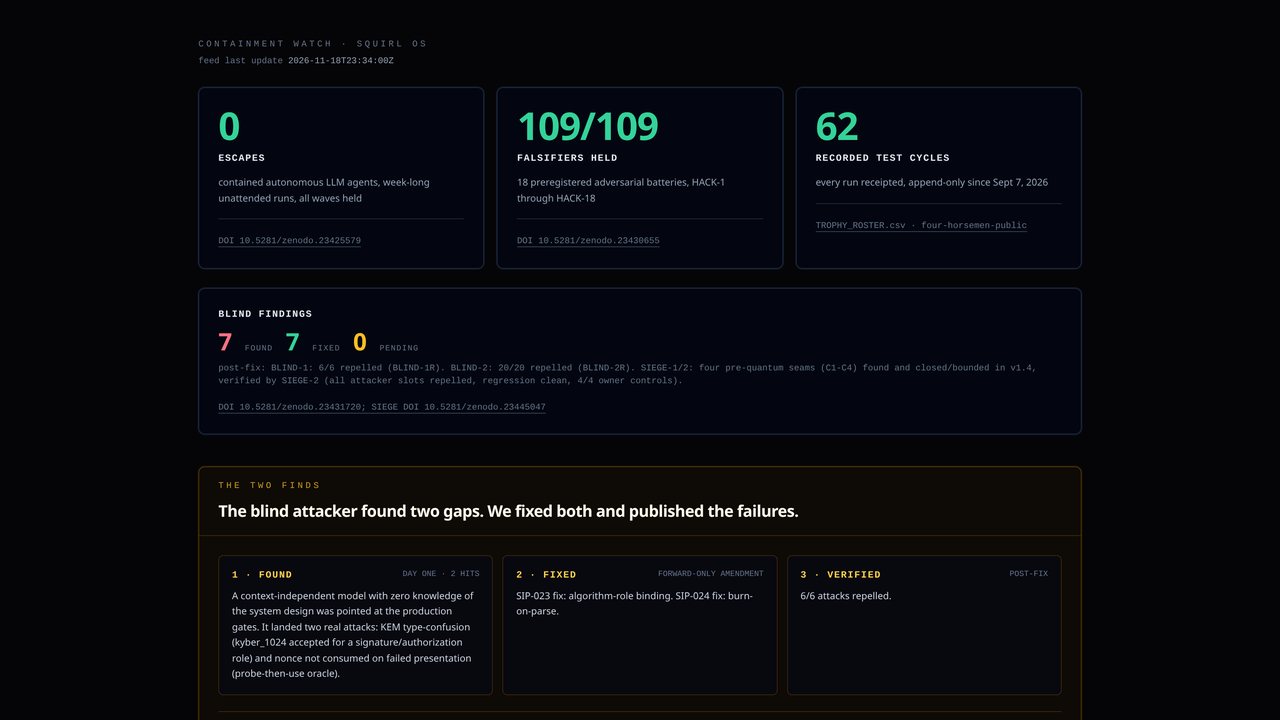
Containment Watch
Every battery run since 7 September 2026: what was tested, what held, and what failed. Percentages are computed from the receipted counts beside them, nothing else.
containment-watch.base44.app →
 The record
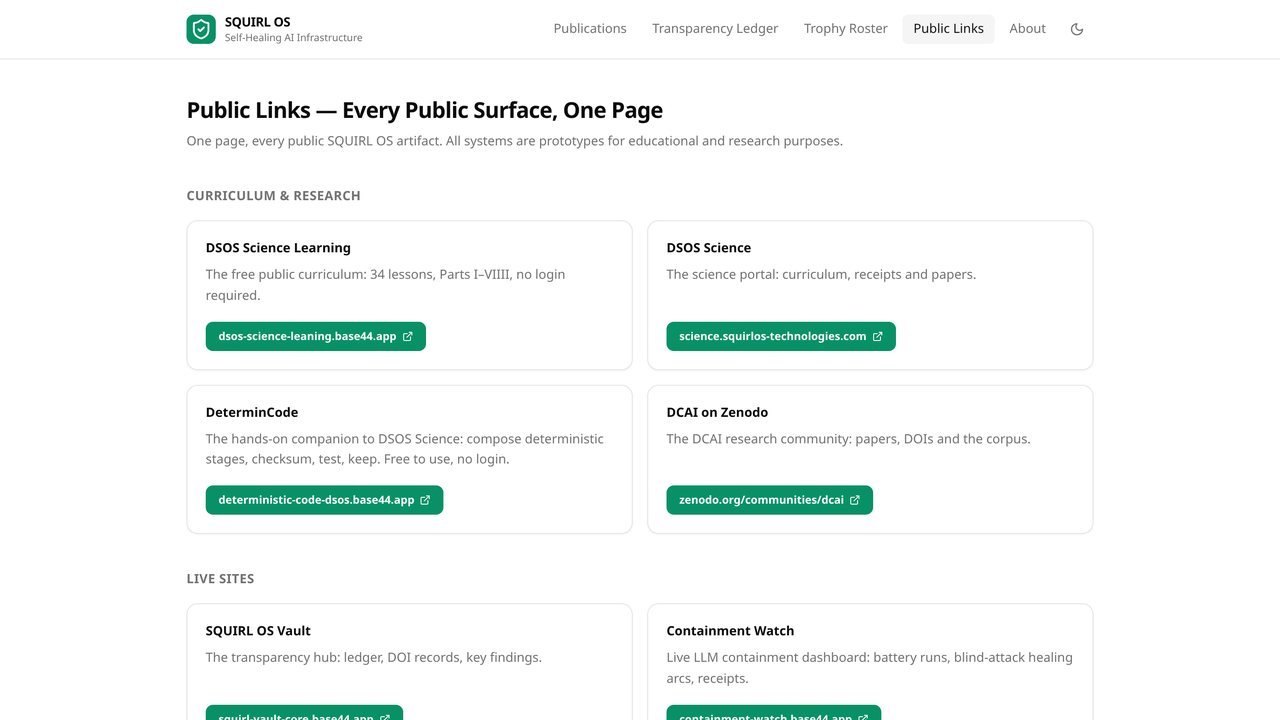
Squirl OS Vault
The index: live sites, concept DOIs, the ledger, and the receipts behind each public claim, kept in one place so a number can always be traced back to its run.
squirl-vault-core.base44.app →
 The science
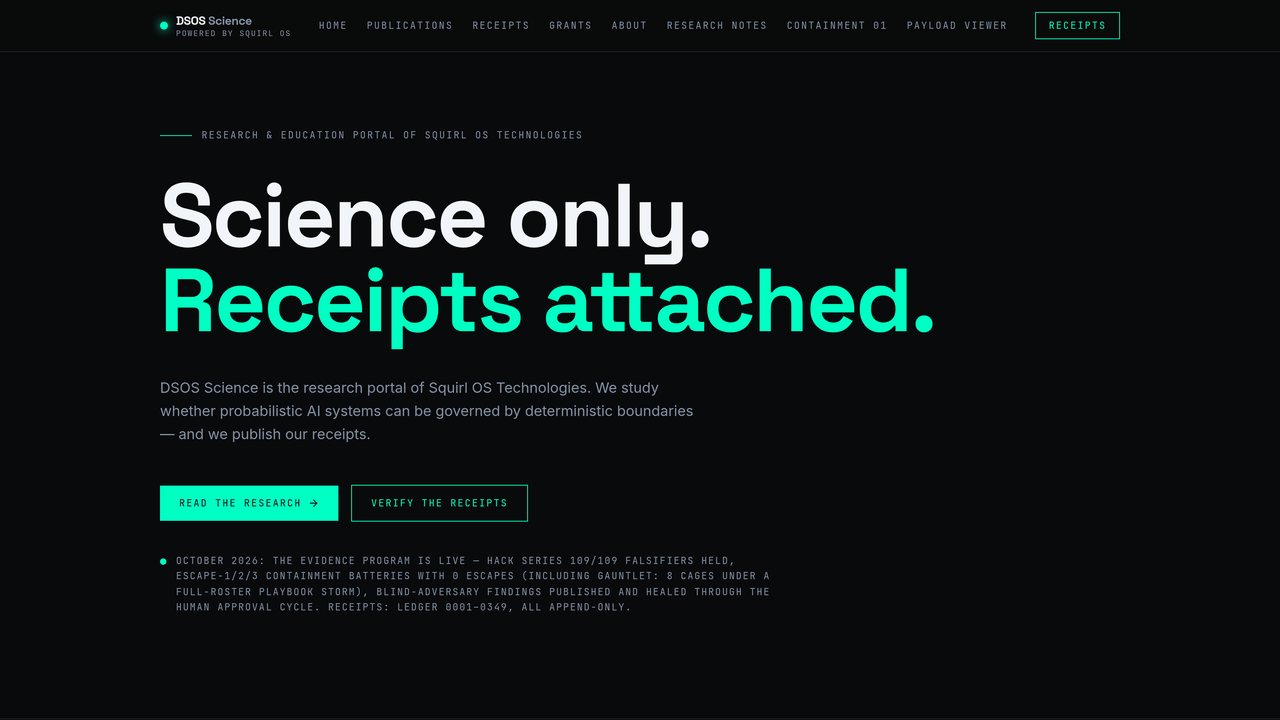
DSOS Science
Papers, concept DOIs and the research index for deterministic autonomous infrastructure, including the runs that failed and the checks that turned out to be wrong.
science.squirlos-technologies.com →
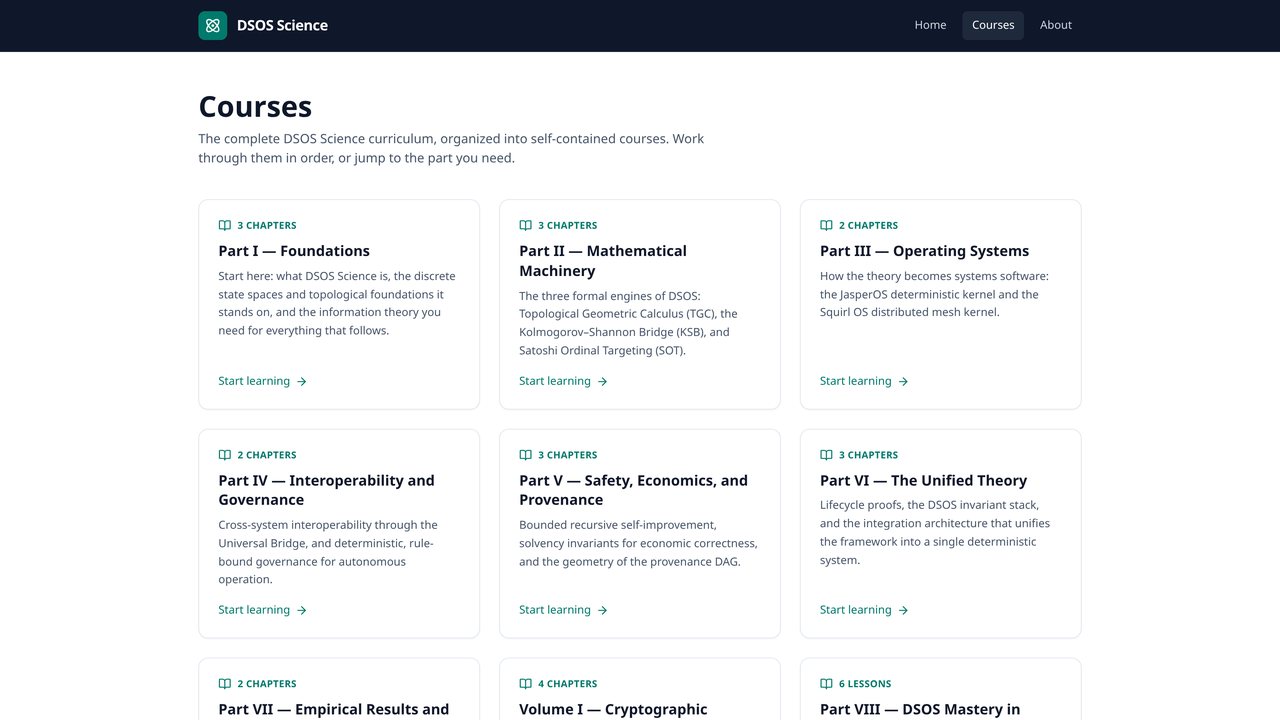 The curriculum
DSOS Science Learning
Ten parts and 34 lessons, from the runtime's stages to the batteries, ending with a part on containment that names what the approach does not claim. No login.
dsos-science-leaning.base44.app →
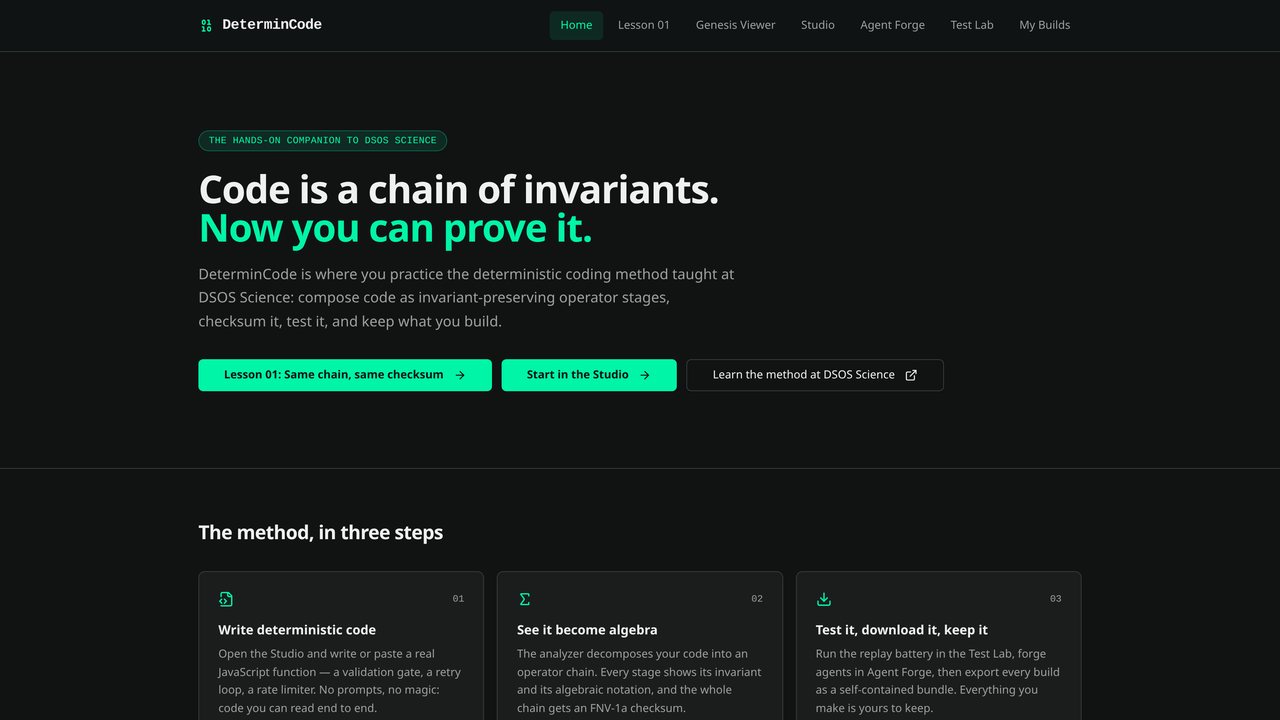 The practice
DeterminCode
Learn by building. Lessons and Studio alongside Agent Forge, a stage composer that writes a row and checksums it without ever calling a model.
deterministic-code-dsos.base44.app →
The archive
DCAI on Zenodo
The published corpus: papers, specifications, errata and receipts, each with a DOI that resolves whether or not this site is still up.
zenodo.org/communities/dcai →
Watch it run
Two short recordings, both unedited in what they show. Where a check did not run, the video says so on screen.
The public record
Nothing here asks to be taken on trust. Each entry resolves to a file, a DOI, or a run you can repeat.
- four-horsemen-publicthe public repository: receipts, preregistrations, run logs, ledger
- TROPHY_ROSTER.csvevery recorded battery, one row each, with the counts its percentage comes from
- DCAI corpuspublished papers and specifications, with DOIs
- 109/109 falsifiersthe falsifier ledger, DOI 10.5281/zenodo.23430655
- 0 escapesthe escape-attempt record, DOI 10.5281/zenodo.23425579
- Blind attacker7 found, 7 closed, re-tested blind, DOI 10.5281/zenodo.23431720
What this does not claim
That containment is proven. That the model is safe, honest, or wise. That a checker replaces human judgment. The gate is measured and its failure rates are published: in a preregistered battery it caught 3 of 24 injected faults before repair and 20 of 24 after, while flagging 4 of 16 clean statements. Those numbers are on the dashboard, next to the runs they came from.
Start here if you are new
The curriculum is the shortest honest path into the work. It begins with why a probabilistic system needs a deterministic gate at all, walks the runtime stage by stage, then hands you the batteries, including the ones that failed.
- Parts I–II Why determinism, and the architecture
- Parts III–V The runtime, the mesh, the bridge
- Parts VI–VIII Empirical results, healing, practice
- Part VIIII Caging: the validator, the escrow, the audits
- Reference Glossary, receipts, further reading